
The Innate Key
The Innate Key: Why the Ayahuasca Experience is a Human Reflex, Not a 'Drug' Hijack
Challenging the Language of Separation
When Western pharmacology looks at Ayahuasca, it often relies on clinical, sterile, and subtly biased language. You will frequently read that exogenous (externally introduced) DMT "hijacks" the brain's serotonin pathways.
But does it?
The word hijack implies an unwanted intruder breaking into a functional system. But when we look closely at human biology and multi-generational traditional evidence, a different hypothesis emerges: The DMT experience is not a foreign disruption, but the activation of an innate, biological reflex.
One Molecule, Two Origins
To understand this reflex, we have to look at the molecule itself. The N,N-Dimethyltryptamine found in the Psychotria viridis leaf is atom-for-atom identical to the endogenous DMT produced naturally within human cells.
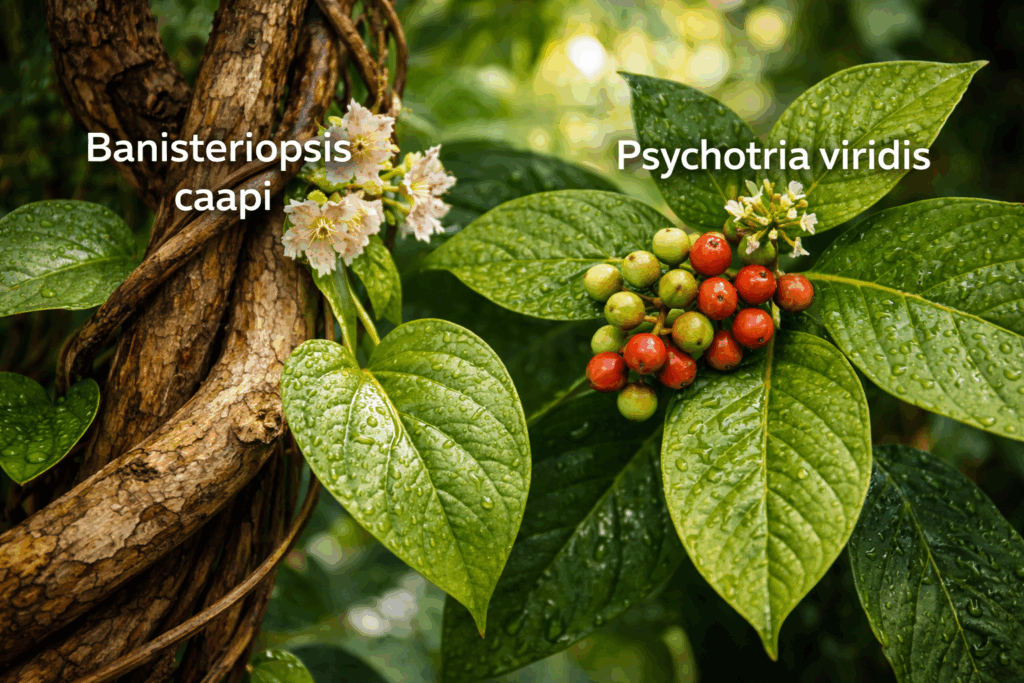
In an indigenous ceremony, the Banisteriopsis caapi vine acts as an organic protector. Its harmala alkaloids temporarily quiet the stomach's monoamine oxidase (MAO) enzymes. This allows the plant's DMT to pass safely into the bloodstream, acting as an external key for a lock that is already built into our genetic code.
But the symbiosis goes further: modern pharmacology shows these specific harmala alkaloids actively stimulate neurogenesis (the growth of new neurons). The vine does not merely facilitate the DMT; it acts in profound biological concert with it to promote cellular growth.
The Cellular Shield: The Sigma-1 Receptor Pathway
The most profound evidence for the "reflex hypothesis" lies deep within our cells at the Sigma-1 Receptor (σ-1R).
Far from being a simple "hallucinogen receptor," the σ-1R is a critical chaperone protein located where the endoplasmic reticulum meets the mitochondria. Its primary physiological job is cellular preservation. When a tissue faces extreme stress—such as hypoxia (lack of oxygen) or oxidative crisis—the Sigma-1 receptor activates to keep the cell alive.

The foundational biology of this hypothesis—that endogenous DMT acts as an innate protective reflex against cellular stress via the σ-1R—is already heavily supported by in vitro and in vivo data. It is highly likely to become accepted scientific consensus over the next decade.
The Catalyst vs. The Generator: Reframing the Vision
If we accept the biological reflex, we must address the visionary experience itself. When examining a Near-Death Experience (NDE), isolating endogenous DMT as the singular "projector" of the visionary state—amidst a massive biochemical cascade of glutamate, endorphins, and oxygen depletion—is practically impossible.
Therefore, we must refine the hypothesis: DMT is not the generator of consciousness, but the primary catalyst that stages it for the journey.
This aligns with the Transmission Model of Consciousness, first proposed by philosopher William James. In this framework, the brain does not create consciousness; it acts as a "reducing valve" or receiver for a broader informational field. A massive DMT surge—whether triggered internally by an NDE or externally via Ayahuasca—acts as a biochemical tuner. By temporarily suppressing the brain's rigid, everyday survival filters, it allows the mind to perceive universal patterns and intelligence that are usually blocked out.
The Biology of Meaning: Parallel Outcomes
This reframing explains a profound parallel between NDEs and Ayahuasca: the defining characteristic of both is not always a visual geometry, but an overwhelming download of meaning, intelligence, and purpose. How does this happen even for individuals who report no visions at all?
- The Collapse of Duality (DMN Suppression): Both physical crises and Ayahuasca profoundly suppress the brain's Default Mode Network (DMN)—the neurological seat of the ego. When the DMN goes offline, the boundary of duality collapses. The result is an undeniable, physiological sensation of absolute unity and connection.
- Hyper-Salience (5-HT2A Activation): DMT binds to the 5-HT2A serotonin receptors, which govern "salience"—how the brain decides what is important. Flooding these receptors flags the experience as "hyper-real" and carrying ultimate meaning.
The aftermath of this encounter creates what we might call an epigenetic response to non-duality. The sheer psychological weight of encountering boundless unity acts as a massive environmental trigger, turning on genes related to neuroplasticity, empathy, and stress resilience to adapt to this expanded state of awareness.
Testing the Reflex Hypothesis
While the exact source of consciousness remains a philosophical frontier, the biological reflex staging it remains highly falsifiable. This hypothesis can be rigorously tested through distinct pharmacological models:
Test A: The Receptor Blockade (In Vitro)
If the neuroprotective benefits of Ayahuasca are truly a σ-1R "reflex," we should be able to turn the reflex off. By inducing hypoxia in neural cells and administering DMT alongside a specific σ-1R antagonist (a chemical that blocks the receptor, such as NE-100), researchers can observe the outcome. If the cells experience massive death despite the presence of DMT, it proves the σ-1R is the exact, necessary mechanism of the protective reflex.
Test B: The Biomarker Correlation (In Vivo)
If Ayahuasca mimics the NDE survival reflex, it should leave identical chemical footprints of cellular repair in the bloodstream. Studies measuring neuroplasticity biomarkers (like Brain-Derived Neurotrophic Factor, or BDNF) and inflammatory cytokines in Ayahuasca participants could be mapped against data from cardiac-arrest survivors. A statistically significant overlap would provide robust evidence that both experiences rely on the exact same innate, evolutionary hardware.
Resolving the Narrative: NDEs vs. Ceremony
By observing the lasting integration, we see how both experiences tap into the exact same innate somatic pathways, yielding strikingly parallel shifts in human consciousness:
| Metric / Observed Outcome | The Near-Death Experience (Innate Surge) | The Ayahuasca Ceremony (Plant-Assisted) |
|---|---|---|
| Primary Trigger | Acute physical trauma, hypoxia, or cardiac arrest. | Intentional, protected consumption of synergistic botanicals. |
| Somatic Target | Endogenous σ-1R and 5-HT2A activation. | Exogenous σ-1R and 5-HT2A activation. |
| Long-Term Shift | Up to 80% report a permanent drop in the fear of death, reduced materialism, and heightened empathy. | Sustained reductions in anxiety and depression, with measurable improvements in psychological flexibility. |
Returning to the Paradigm of Symbiosis
When we move past the restrictive mentality of mid-century political classifications, the relationship between human biology and traditional plant medicines becomes clear.
Ayahuasca does not "hijack" the mind. It provides a gentle, external mirror to an internal reflex—acting as the catalyst that allows us to step consciously into a profound, self-preservational state of healing, insight, and universal connection that our bodies already know how to achieve.
References for the Reflex Hypothesis
- Fontanilla, D., et al. (2009). "The Hallucinogen N,N-Dimethyltryptamine (DMT) Is an Endogenous Sigma-1 Receptor Regulator." Science, 323(5916), 934-937. (Proves DMT acts as a natural ligand for the cellular preservation receptor).
- Szabo, A., et al. (2014). "The Endogenous Hallucinogen and Trace Amine N,N-Dimethyltryptamine (DMT) Displays Potent Protective Effects against Hypoxia via the Sigma-1 Receptor." PLoS ONE, 9(9). (Confirms the survival reflex model in human neural cells).
- Dean, J. G., et al. (2019). "Biosynthesis and Extracellular Concentrations of N,N-dimethyltryptamine (DMT) in Mammalian Brain." Scientific Reports, 9(1). (Monitors the endogenous DMT surge during experimentally induced cardiac arrest).
 English
 Afrikaans
 Albanian
 Amharic
 Arabic
 Armenian
 Azerbaijani
 Basque
 Belarusian
 Bengali
 Bosnian
 Bulgarian
 Catalan
 Cebuano
 Chichewa
 Chinese (Simplified)
 Chinese (Traditional)
 Corsican
 Croatian
 Czech
Czech Danish
 Dutch
Dutch Esperanto
 Estonian
 Filipino
 Finnish
 French
 Frisian
 Galician
 Georgian
 German
 Greek
Greek Gujarati
 Haitian Creole
 Hausa
Hausa Hawaiian
 Hebrew
 Hindi
Hindi Hmong
Hmong Hungarian
 Icelandic
 Igbo
Igbo Indonesian
 Irish
Irish Italian
 Japanese
 Javanese
 Kannada
 Kazakh
 Khmer
Khmer Korean
 Kurdish (Kurmanji)
 Kyrgyz
 Lao
Lao Latin
Latin Latvian
 Lithuanian
 Luxembourgish
 Macedonian
 Malagasy
 Malay
Malay Malayalam
 Maltese
 Maori
Maori Marathi
 Mongolian
 Myanmar (Burmese)
 Nepali
 Norwegian
 Pashto
 Persian
 Polish
 Portuguese
 Punjabi
 Romanian
 Russian
 Samoan
 Scottish Gaelic
 Serbian
 Sesotho
 Shona
Shona Sindhi
 Sinhala
 Slovak
 Slovenian
 Somali
 Spanish
 Sudanese
 Swahili
 Swedish
 Tajik
Tajik Tamil
Tamil Telugu
 Thai
Thai Turkish
 Ukrainian
 Urdu
Urdu Uzbek
Uzbek Vietnamese
 Welsh
Welsh Xhosa
Xhosa Yiddish
 Yoruba
 Zulu
Zulu